Myasthenia gravis (MG) is an autoimmune neuromuscular disorder caused by autoantibodies targeting the postsynaptic membrane at the neuromuscular junction (NMJ), leading to fatigable skeletal muscle weakness. Anti-acetylcholine receptor (AChR) antibodies are present in ~85% of generalized MG, mediating NMJ destruction through complement-dependent membrane attack complex (MAC) formation, antigenic modulation (cross-linking and internalization of AChR), and functional AChR blockade. Anti-MuSK antibodies (~5–8%) define a distinct IgG4-mediated subtype with different clinical features and treatment response, while anti-LRP4 antibodies account for a proportion of previously "seronegative" patients. Therapeutic options include complement C5 inhibitors (eculizumab, ravulizumab, zilucoplan), FcRn antagonists (efgartigimod, rozanolixizumab) for IgG reduction, anti-CD20 (rituximab, particularly effective in MuSK-MG), cholinesterase inhibitors, and thymectomy.
Research Use Only (RUO)Not intended for diagnostic or therapeutic procedures.
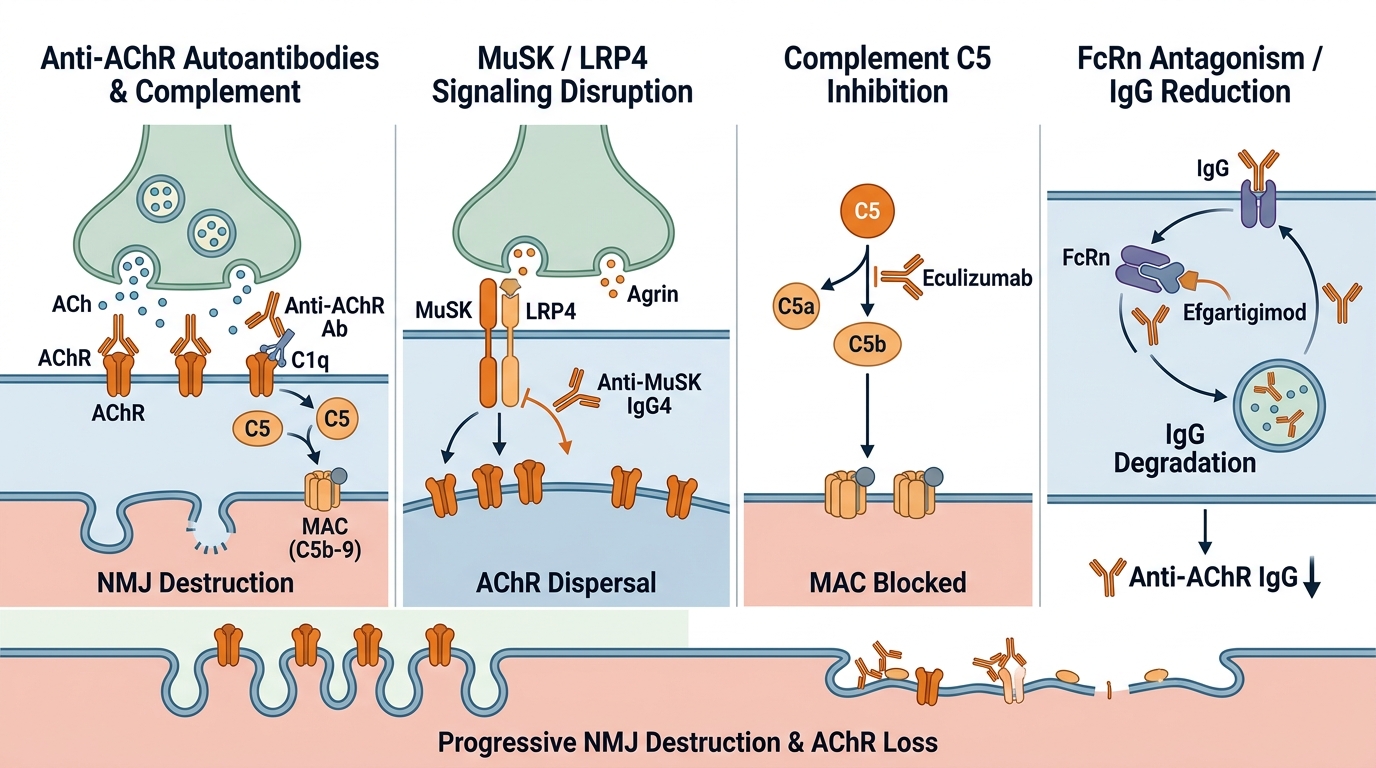
Fig. 1 Key pathogenic pathways in myasthenia gravis. Anti-AChR autoantibodies activate complement C5/MAC at the NMJ; anti-MuSK (IgG4) disrupts agrin-LRP4-MuSK signaling; complement C5 inhibitors and FcRn antagonists represent major therapeutic targets. Key research targets highlighted in orange.
abinScience provides validated anti-AChR recombinant antibodies (clone Mab35 with fluorescent conjugates), anti-MuSK and anti-LRP4 antibodies, the broadest complement C5 reference antibody panel (8 reference antibodies including eculizumab with full ADA toolkit), and FcRn antagonist reference antibodies (6 reference antibodies). All products are manufactured by our parent company AtaGenix Laboratories under ISO quality systems. Browse products below or contact us for custom antibody development.
AChR (CHRNA1) — The primary autoantigen in ~85% of generalized MG. Anti-AChR autoantibodies mediate NMJ destruction through three mechanisms: complement-dependent MAC formation, antigenic modulation (AChR cross-linking and internalization), and direct functional blockade. Anti-CHRNA1 recombinant antibody (clone Mab35) — the most widely used anti-AChR research clone — is available with fluorescent conjugates (FITC, PE, APC, PerCP) for flow cytometric AChR detection, complement fixation studies, and EAMG (experimental autoimmune MG) animal model research.
→ Browse AChR / CHRNA1 antibodies
MuSK / LRP4 — Anti-MuSK antibodies (primarily IgG4) define a distinct MG subtype (~5–8%) characterized by bulbar-predominant weakness and poor response to cholinesterase inhibitors. MuSK is a receptor tyrosine kinase essential for agrin-LRP4-MuSK signaling and AChR clustering at the NMJ. Anti-LRP4 antibodies account for a subset of previously seronegative MG. abinScience offers anti-MuSK reference antibody (Adimanebart), anti-MuSK recombinant antibody (SAA1506), MuSK recombinant protein, anti-MuSK pAb, and anti-LRP4 recombinant antibodies (clones N164/6, N164/7, N207/27) plus human/mouse Agrin recombinant proteins for NMJ signaling research.
→ Browse MuSK & LRP4 antibodies
Complement C5 — Complement C5 cleavage and MAC (C5b-9) formation at the NMJ is the principal effector mechanism of anti-AChR autoantibody-mediated damage. Complement C5 inhibitors (eculizumab, ravulizumab) are approved for AChR-positive generalized MG. abinScience offers the broadest anti-complement C5 reference antibody panel available: eculizumab, ravulizumab, olendalizumab, tesidolumab, crovalimab, pozelimab, pexelizumab, and vilobelimab. A complete eculizumab ADA toolkit (drug-level ELISA, anti-eculizumab ELISA, NAb ELISA, anti-eculizumab pAb) supports TDM and immunogenicity research.
→ Browse complement C5 antibodies & ELISA kits
FcRn (FCGRT) — FcRn maintains pathogenic IgG levels by recycling IgG from lysosomal degradation. FcRn antagonists reduce total IgG (including anti-AChR autoantibodies) and are the newest approved drug class for MG. abinScience offers 6 anti-FcRn reference antibodies: efgartigimod, rozanolixizumab, batoclimab, nipocalimab, orilanolimab, and HBM9161, supporting mechanism-of-action studies, biosimilar characterization, and immunogenicity monitoring across multiple FcRn-targeting programs.
→ Browse FcRn antibodies & proteins
1. Gilhus NE, et al. Myasthenia gravis. Nat Rev Dis Primers. 2019;5(1):30. DOI
2. Howard JF Jr, et al. Efgartigimod for generalized myasthenia gravis. N Engl J Med. 2021;385(22):2005-2016. DOI
3. Howard JF Jr, et al. Safety and efficacy of eculizumab in anti-acetylcholine receptor antibody-positive refractory generalised myasthenia gravis. Lancet Neurol. 2017;16(12):976-986. DOI
Human
ELISA, Bioactivity: FACS, Functional assay, Research in vivo
Human
IgG1-kappa
Human
ELISA, FCM, WB, IHC, IF
Human
IgG1, kappa
SAA2008
Human
ELISA, FCM, WB
Human
IgG4, kappa
SAA2009
Human
FCM
Human
IgG1, lambda
BlySmAb-1.1
Human
FCM
Human
IgG4, kappa
SAA0136
Human
FCM
Human
IgG4, kappa
SAA0135
Human
ELISA, Bioactivity: FACS, Functional assay, Research in vivo
Human
IgG1-kappa
Human
ELISA, Bioactivity: FACS, Functional assay, Research in vivo
Human
IgG1-kappa
Human
ELISA, Bioactivity: FACS, Functional assay, Research in vivo
Human
IgG2-G4-kappa
Human
ELISA, Bioactivity: FACS, Functional assay, Research in vivo
Human
IgG1-lambda