中文
中文 English
 한국어
한국어 日本語
日本語 Español
 Français
 Русский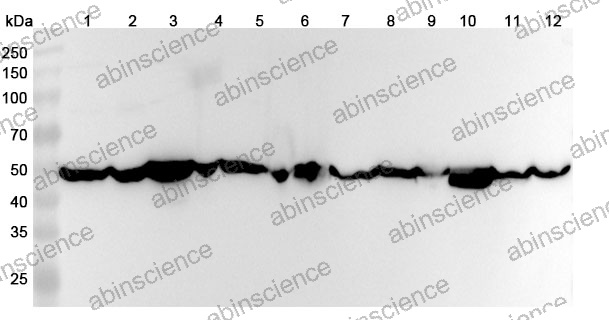
| Catalog No. | HY081014 | ||||||||
|---|---|---|---|---|---|---|---|---|---|
| Description |
Anti-ENO1 Polyclonal Antibody (HY081014) is a rabbit polyclonal antibody detecting ENO1 in ELISA, IHC, WB. Suitable for Human, Mouse, Rat, Anas platyrhynchos, and Bovine.
Highlights
|
||||||||
| Species reactivity | Human, Mouse, Rat | ||||||||
| Applications | ELISA, IHC, WB | ||||||||
| Host species | Rabbit | ||||||||
| Clonality | Polyclonal | ||||||||
| Isotype | IgG | ||||||||
| Immunogen | E. coli - derived recombinant Human ENO1 (Pro267-Leu354). | ||||||||
| Target | Non-neural enolase, 2-phospho-D-glycerate hydro-lyase, MPB-1, ENO1, Plasminogen-binding protein, Enolase 1, C-myc promoter-binding protein, Alpha-enolase, MBP-1, MBPB1, MPB1, ENO1L1, NNE, Phosphopyruvate hydratase | ||||||||
| Purification | Purified by antigen affinity column. | ||||||||
| Accession | P06733 | ||||||||
| Form | Liquid | ||||||||
| Storage buffer | 0.01M PBS, pH 7.4, 50% Glycerol, 0.05% Proclin 300. Please refer to the specific buffer information in the hardcopy of datasheet or the lot-specific COA. |
||||||||
| Product Usage Information |
| ||||||||
| Stability and Storage | Use a manual defrost freezer and avoid repeated freeze thaw cycles. Store at 2 to 8°C for frequent use. Store at -20 to -80°C for twelve months from the date of receipt. | ||||||||
| Background | Alpha-enolase (ENO1) is a ~47 kDa protein. Enolase that catalyzes the conversion of 2-phosphoglycerate to phosphoenolpyruvate in glycolysis and the reverse reaction in gluconeogenesis. Also involved in various processes such as growth control, hypoxia tolerance and allergic responses. May also function in the intravascular and pericellular fibrinolytic system due to its ability to serve as a receptor and activator of plasminogen on the cell surface of several cell-types such as leukocytes and neurons. Stimulates immunoglobulin production. 1. Sugahara, T. et al. (1992) Cytotechnology 10, 137-46. PMID: 1369209 2. Huang, H. et al. (2018) Molecular cell 70, 663-678.e6. PMID: 29775581 3. Feo, S. et al. (2000) FEBS letters 473, 47-52. PMID: 10802057 4. López-Alemany, R. et al. (2003) American journal of hematology 72, 234-42. PMID: 12666133 5. Ray, R. et al. (1991) Molecular and cellular biology 11, 2154-61. PMID: 2005901 | ||||||||
| Note | For research use only. |
Western blot analysis was performed using anti-ENO1 polyclonal antibody at 1ug/mL on various samples.
Lane 1: Hela cell lysate
Lane 2: LO2 cell lysate
Lane 3: PC-3 cell lysate
Lane 4: SGC-7901 cell lysate
Lane 5: MCF-7 cell lysate
Lane 6: Mouse lung lysate
Lane 7: Mouse skeletal muscle lysate
Lane 8: Mouse brain lysate
Lane 9: Rat lung lysate
Lane 10: Rat skeletal muscle lysate
Lane11: Rat brain lysate


Contact us for custom quotes, bulk requests and any other issues.
Mail: [email protected]
+86-27-65523339
Building C, No. 666, Shen Dun Si Lu, Wuhan, 430206, China