
 中文
中文 English
 한국어
한국어 日本語
日本語 Español
 Français
 Русский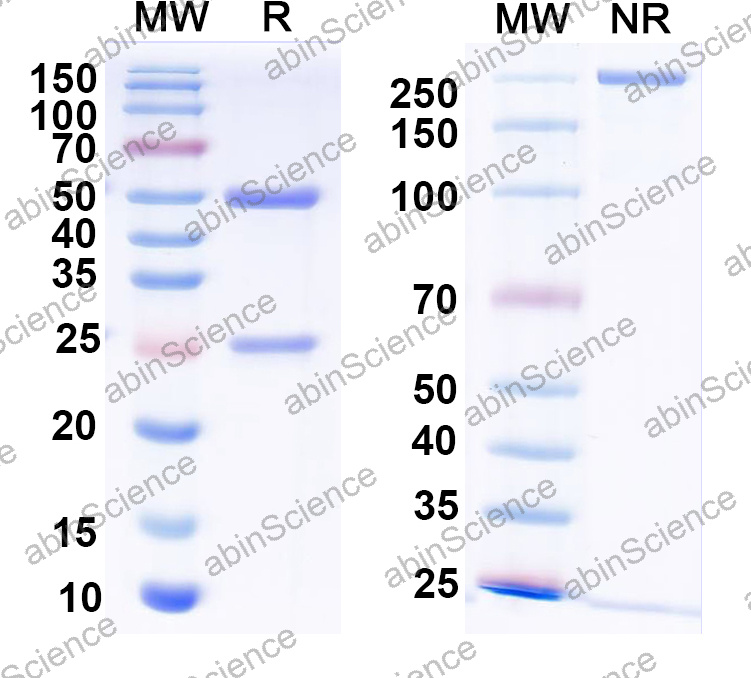
| Catalog No. | HC151025 |
|---|---|
| Description |
Anti-Human ATP5PB Monoclonal Antibody (1A481) [1A481] (HC151025) is a mouse monoclonal antibody detecting ATP5PB in ELISA, IHC, WB. Suitable for Human.
Highlights
|
| Species reactivity | Human |
| Applications | ELISA, IHC, WB |
| Host species | Mouse |
| Isotype | IgG |
| Clone ID | 1A481 |
| Clonality | Monoclonal |
| Immunogen | E. coli - derived recombinant human ATP5PB (Ser96-Met256). |
| Target | ATP synthase peripheral stalk subunit b mitochondrial, ATP synthase F(0) complex subunit B1 mitochondrial, ATP synthase peripheral stalk-membrane subunit b, ATP synthase proton-transporting mitochondrial F(0) complex subunit B1, ATP synthase subunit b, ATPase subunit b, ATP5PB |
| Purification | Protein A/G purified from cell culture supernatant. |
| Accession | P24539 |
| Form | Liquid |
| Storage buffer | 0.01M PBS pH 7.4 Please refer to the specific buffer information in the hardcopy of datasheet or the lot-specific COA. |
| Stability and Storage | Use a manual defrost freezer and avoid repeated freeze thaw cycles. Store at 2 to 8°C for frequent use. Store at -20 to -80°C for twelve months from the date of receipt. |
| Background | ATP synthase peripheral stalk subunit b, mitochondrial (ATP5PB) is a ~28 kDa protein. Subunit b, of the mitochondrial membrane ATP synthase complex (F(1)F(0) ATP synthase or Complex V) that produces ATP from ADP in the presence of a proton gradient across the membrane which is generated by electron transport complexes of the respiratory chain. ATP synthase complex consist of a soluble F(1) head domain - the catalytic core - and a membrane F(1) domain - the membrane proton channel. These two domains are linked by a central stalk rotating inside the F(1) region and a stationary peripheral stalk. During catalysis, ATP synthesis in the catalytic domain of F(1) is coupled via a rotary mechanism of the central stalk subunits to proton translocation (Probable). In vivo, can only synthesize ATP although its ATP hydrolase activity can be activated artificially in vitro. 1. Lai, Y. et al. (2023) Molecular cell 83, 2137-2147.e4. PMID: 37244256 |
| Note | For research use only. |
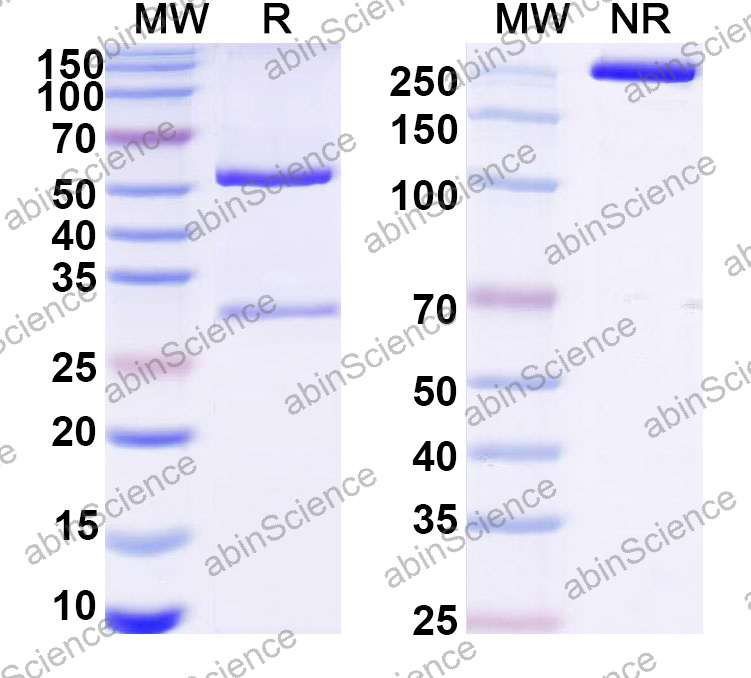
SDS-PAGE for Anti-Human ATP5PB Monoclonal Antibody (1A481)

Contact us for custom quotes, bulk requests and any other issues.
Mail: support@abinScience.com
+86-27-65523339
Building C, No. 666, Shen Dun Si Lu, Wuhan, 430206, China


