Please ensure Javascript is enabled for purposes of website accessibility
Home > Products > Recombinant Proteins > Other Proteins

Human ATP5PB Recombinant Protein (N-His) (HC151012)

Price(USD):
Spec:
  • 50ug
  • 100ug
  • 1mg
Number:
Get quote
  • Overview

  • Images

  • References

  • Datasheet

  • SDS

Overview
Catalog No.HC151012
Description
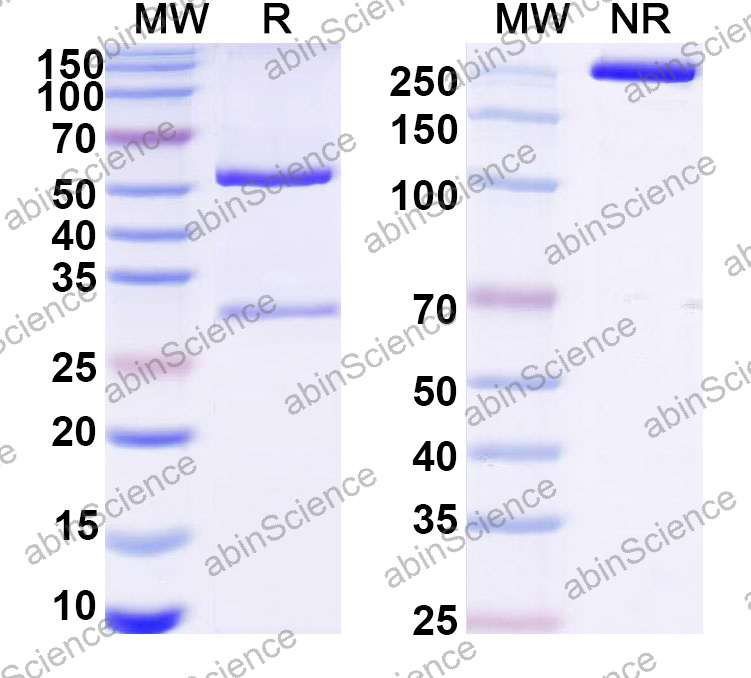
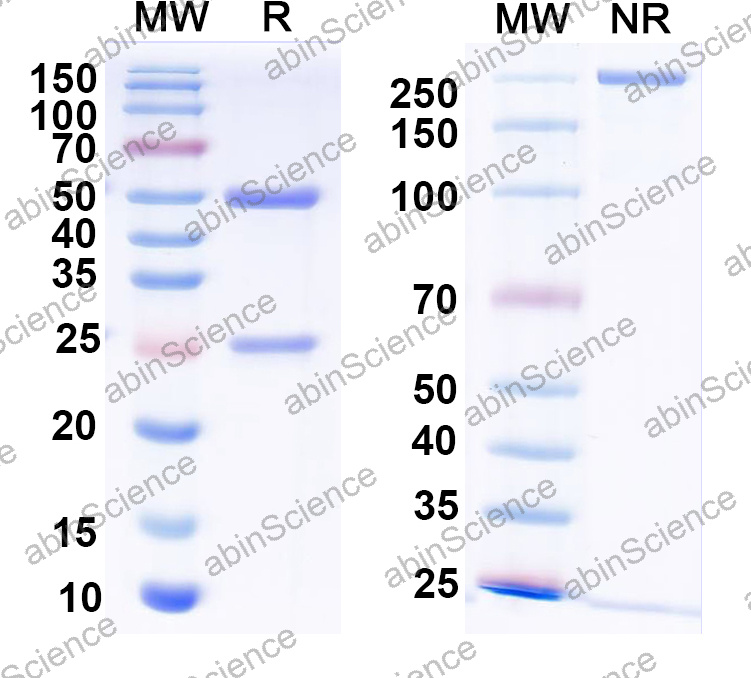
Recombinant Human ATP5PB Protein, N-His (HC151012) expressed in E. coli, spanning Ser96-Met256. Purity: >90% by SDS-PAGE.
Highlights
  • His-Tagged — N-terminal 6×His tag for IMAC purification.
  • E. coli Expression — High-yield, cost-effective production.
  • High Purity — >90% purity verified by SDS-PAGE.
Expression systemE. coli
AccessionP24539
Protein lengthSer96-Met256
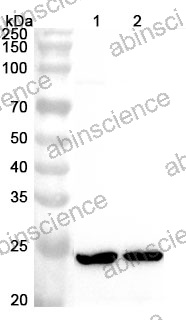
ApplicationsELISA, Immunogen, SDS-PAGE, WB, Bioactivity testing in progress
SpeciesHomo sapiens (Human)
Nature Recombinant
Endotoxin level Please contact with the lab for this information.
Purity >90% as determined by SDS-PAGE.
Predicted molecular weight 21.03 kDa
Form Lyophilized
Storage buffer Lyophilized from a solution in PBS pH 7.4, 1 mM EDTA, 4% Trehalose, 1% Mannitol.

Please refer to the specific buffer information in the hardcopy of datasheet or the lot-specific COA.

Reconstitution Reconstitute in sterile water for a stock solution. Adjust the volume of sterile water so that, after reconstitution, the final stock concentration matches the value indicated on the product label or datasheet.

RECONSTITUTION PROTOCOL
1. Allow the product to be reconstituted and the reconstitution diluent to reach room temperature.
2. Tap or briefly centrifuge the product vial before opening to dislodge any lyophilized material that may be dispersed on the wall or cap of the vial.
3. Use the diluent and stock concentration recommended in the product datasheet. If preparing a stock concentration higher than recommended, contact Technical Service.
4. After adding the diluent, re-cap the vial and invert gently by hand or place on a slow rocking platform to allow the reconstitution diluent to coat all the surfaces inside the vial. Note: Do not mix by vortexing or by pipetting the material up and down.
5. Allow the vial to sit at room temperature with gentle agitation for at least 15 minutes before aliquotting or using.
6. Store the reconstituted material in single use aliquots in polypropylene or siliconized tubes. Aliquots of 10 μL or larger are recommended.
Shipping In general, proteins are provided as lyophilized powder/frozen liquid. They are shipped out with dry ice/blue ice unless customers require otherwise.
Stability and Storage Use a manual defrost freezer and avoid repeated freeze thaw cycles. Store at 2 to 8°C for frequent use. Store at -20 to -80°C for twelve months from the date of receipt.
Alternate NamesATP synthase F(0) complex subunit B1, mitochondrial, ATP synthase peripheral stalk subunit b, mitochondrial, ATP synthase peripheral stalk-membrane subunit b, ATP synthase proton-transporting mitochondrial F(0) complex subunit B1, ATP synthase subunit b, ATP5F1, ATP5PB, ATPase subunit b
Background

ATP synthase peripheral stalk subunit b, mitochondrial is a ~28 kDa protein. Subunit b, of the mitochondrial membrane ATP synthase complex (F(1)F(0) ATP synthase or Complex V) that produces ATP from ADP in the presence of a proton gradient across the membrane which is generated by electron transport complexes of the respiratory chain. ATP synthase complex consist of a soluble F(1) head domain - the catalytic core - and a membrane F(1) domain - the membrane proton channel. These two domains are linked by a central stalk rotating inside the F(1) region and a stationary peripheral stalk. During catalysis, ATP synthesis in the catalytic domain of F(1) is coupled via a rotary mechanism of the central stalk subunits to proton translocation (Probable). In vivo, can only synthesize ATP although its ATP hydrolase activity can be activated artificially in vitro.

1. Lai, Y. et al. (2023) Molecular cell 83, 2137-2147.e4. PMID: 37244256
Note For research use only
Images
References
Formula
Mass (g) = Concentration (mol/L) × Volume (L) × MW (g/mol)
Enter any 2 of Mass, Concentration, Volume + Molecular Weight to solve for the unknown.
Mass
=
Concentration
×
Volume
Molecular Weight *
g/mol
Formula
C₁ × V₁ = C₂ × V₂
Enter any 3 of the 4 values to solve for the unknown.
Stock Solution
C₁ (Stock Conc.)
×
V₁ (Stock Vol.)
=
Working Solution
C₂ (Working Conc.)
×
V₂ (Working Vol.)
Recommendation

Contact us for custom quotes, bulk requests and any other issues.

Mail: support@abinScience.com

Distributor list