中文
中文 English
 한국어
한국어 日本語
日本語 Español
 Français
 Русский

| Catalog No. | HA565014 | ||||||||
|---|---|---|---|---|---|---|---|---|---|
| Description |
Anti-Human CYP1B1 Polyclonal Antibody (HA565014) is a rabbit polyclonal antibody detecting CYP1B1. Suitable for Human.
|
||||||||
| Species reactivity | Human | ||||||||
| Applications | ELISA, IHC, WB | ||||||||
| Host species | Rabbit | ||||||||
| Clonality | Polyclonal | ||||||||
| Isotype | IgG | ||||||||
| Immunogen | E. coli - derived recombinant Human CYP1B1 (Leu224-Asp492). | ||||||||
| Target | CYP1B1, CYPIB1, Cytochrome P450 1B1, EC:1.14.14.1, EC:4.2.1.152, Hydroperoxy icosatetraenoate dehydratase | ||||||||
| Endotoxin level | Please contact with the lab for this information. | ||||||||
| Purification | Purified by antigen affinity column. | ||||||||
| Accession | Q16678 | ||||||||
| Form | Liquid | ||||||||
| Storage buffer | 0.01M PBS, pH 7.4, 50% Glycerol, 0.05% Proclin 300. Please refer to the specific buffer information in the hardcopy of datasheet or the lot-specific COA. |
||||||||
| Product Usage Information |
| ||||||||
| Background | Cytochrome P450 1B1 (CYP1B1) is a ~60 kDa protein. A cytochrome P450 monooxygenase involved in the metabolism of various endogenous substrates, including fatty acids, steroid hormones and vitamins. Mechanistically, uses molecular oxygen inserting one oxygen atom into a substrate, and reducing the second into a water molecule, with two electrons provided by NADPH via cytochrome P450 reductase (NADPH--hemoprotein reductase). Exhibits catalytic activity for the formation of hydroxyestrogens from estrone (E1) and 17beta-estradiol (E2), namely 2- and 4-hydroxy E1 and E2. Displays a predominant hydroxylase activity toward E2 at the C-4 position. Metabolizes testosterone and progesterone to B or D ring hydroxylated metabolites. 1. Chen, H. et al. (2000) Drug metabolism and disposition: the biological fate of chemicals 28, 315-22. PMID: 10681376 2. Badawi, AF. et al. (2001) Metabolism: clinical and experimental 50, 1001-3. PMID: 11555828 3. Lee, AJ. et al. (2003) Endocrinology 144, 3382-98. PMID: 12865317 4. Choudhary, D. et al. (2004) Drug metabolism and disposition: the biological fate of chemicals 32, 840-7. PMID: 15258110 5. Mesaros, C. et al. (2010) Rapid communications in mass spectrometry : RCM 24, 3237-47. PMID: 20972997 | ||||||||
| Note | For research use only |
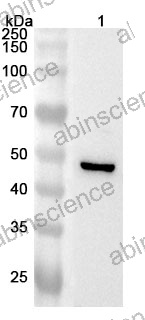
Lane 1: Hela cell lysate
Contact us for custom quotes, bulk requests and any other issues.
Mail: [email protected]
+86-27-65523339
Building C, No. 666, Shen Dun Si Lu, Wuhan, 430206, China