中文
 English
 한국어
 日本語
 Español
 Français
 Русский
| Catalog No. | HY200025 |
|---|---|
| Description |
Anti-Human HMGB1 Monoclonal Antibody (1A068) [1A068] (HY200025) is a mouse monoclonal antibody detecting HMGB1 in ELISA, IHC, WB. Suitable for Human.
Highlights
|
| Species reactivity | Human |
| Applications | ELISA, IHC, WB |
| Host species | Mouse |
| Clonality | Monoclonal |
| Isotype | IgG1 |
| Clone ID | 1A068 |
| Immunogen | Mammalian cells - derived recombinant Human HMGB1 (Met1-Glu215). |
| Target | High mobility group protein B1, HMGB1, HMG1, HMG-1, High mobility group protein 1, |
| Endotoxin level | Please contact with the lab for this information. |
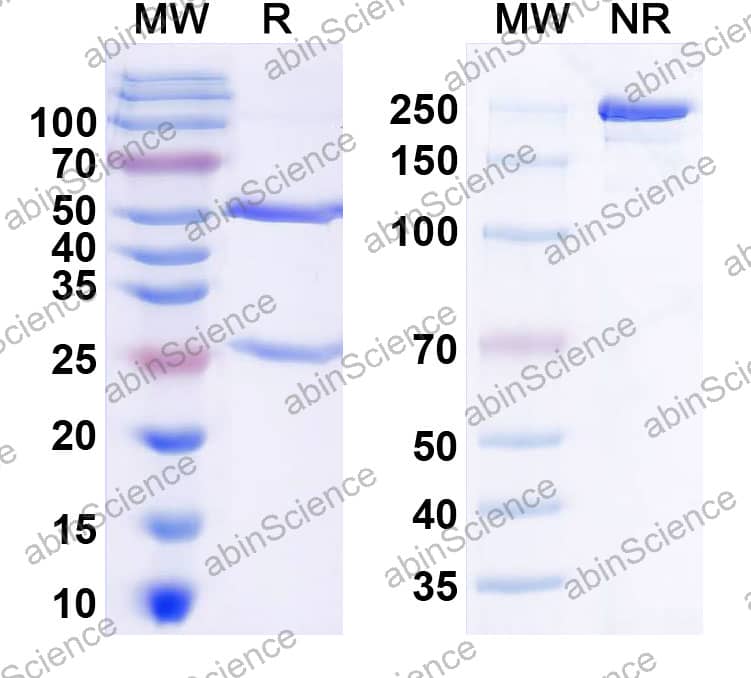
| Purity | >95% as determined by SDS-PAGE. |
| Purification | Protein A/G purified from cell culture supernatant. |
| Accession | P09429 |
| Form | Liquid |
| Storage buffer | 0.01M PBS pH 7.4. Please refer to the specific buffer information in the hardcopy of datasheet or the lot-specific COA. |
| Stability and Storage | Use a manual defrost freezer and avoid repeated freeze thaw cycles. Store at 2 to 8°C for frequent use. Store at -20 to -80°C for twelve months from the date of receipt. |
| Background | High mobility group protein B1 (HMGB1) is a ~24 kDa protein. Multifunctional redox sensitive protein with various roles in different cellular compartments. In the nucleus is one of the major chromatin-associated non-histone proteins and acts as a DNA chaperone involved in replication, transcription, chromatin remodeling, V(D)J recombination, DNA repair and genome stability. Proposed to be an universal biosensor for nucleic acids. Promotes host inflammatory response to sterile and infectious signals and is involved in the coordination and integration of innate and adaptive immune responses. In the cytoplasm functions as a sensor and/or chaperone for immunogenic nucleic acids implicating the activation of TLR9-mediated immune responses, and mediates autophagy. 1. Wei, J. et al. (2021) Cell 184, 76-91.e13. PMID: 33147444 2. Avgousti, DC. et al. (2016) Nature 535, 173-7. PMID: 27362237 3. Wang, G. et al. (2021) Cell death discovery 7, 337. PMID: 34743181 4. Yang, H. et al. (2013) Journal of leukocyte biology 93, 865-73. PMID: 23446148 5. Li, G. et al. (2013) Frontiers in immunology 4, 68. PMID: 23519706 6. Li, G. et al. (2013) Seminars in cancer biology 23, 380-90. PMID: 23994764 7. Lee, SA. et al. (2014) Yonsei medical journal 55, 1165-76. PMID: 25048472 8. Min, HJ. et al. (2013) Journal of immunology (Baltimore, Md. : 1950) 190, 1797-806. PMID: 23303669 9. Lee, LC. et al. (2014) PloS one 9, e115809. PMID: 25549101 |
| Note | For research use only. |
SDS-PAGE for Anti-Human HMGB1 Monoclonal Antibody (1A068)


Contact us for custom quotes, bulk requests and any other issues.
Mail: [email protected]
Contact Us
+86-27-65523339
Building C, No. 666, Shen Dun Si Lu, Wuhan, 430206, China