
 中文
中文 English
 한국어
한국어 日本語
日本語 Español
 Français
 Русский
| Catalog No. | HD617014 | ||||||||
|---|---|---|---|---|---|---|---|---|---|
| Description |
Anti-Human KPNB1 Polyclonal Antibody (HD617014) is a rabbit polyclonal antibody detecting KPNB1. Suitable for Mouse, Rat, and Human.
Highlights
|
||||||||
| Species reactivity | Human, Mouse, Rat | ||||||||
| Applications | ELISA, IHC, WB | ||||||||
| Host species | Rabbit | ||||||||
| Isotype | IgG | ||||||||
| Clonality | Polyclonal | ||||||||
| Immunogen | E. coli - derived recombinant Human KPNB1 (Met1-Ala442). | ||||||||
| Target | Importin subunit beta-1, Importin-90, KPNB1, Karyopherin subunit beta-1, NTF97, Nuclear factor p97, PTAC97, Pore targeting complex 97 kDa subunit | ||||||||
| Endotoxin level | Please contact with the lab for this information. | ||||||||
| Purification | Purified by antigen affinity column. | ||||||||
| Accession | Q14974 | ||||||||
| Form | Liquid | ||||||||
| Storage buffer | 0.01M PBS, pH 7.4, 50% Glycerol, 0.05% Proclin 300. Please refer to the specific buffer information in the hardcopy of datasheet or the lot-specific COA. |
||||||||
| Product Usage Information |
| ||||||||
| Background | Importin subunit beta-1 (KPNB1) is a ~97 kDa protein. Functions in nuclear protein import, either in association with an adapter protein, like an importin-alpha subunit, which binds to nuclear localization signals (NLS) in cargo substrates, or by acting as autonomous nuclear transport receptor. Acting autonomously, serves itself as NLS receptor. Docking of the importin/substrate complex to the nuclear pore complex (NPC) is mediated by KPNB1 through binding to nucleoporin FxFG repeats and the complex is subsequently translocated through the pore by an energy requiring, Ran-dependent mechanism. At the nucleoplasmic side of the NPC, Ran binds to importin-beta and the three components separate and importin-alpha and -beta are re-exported from the nucleus to the cytoplasm where GTP hydrolysis releases Ran from importin. The directionality of nuclear import is thought to be conferred by an asymmetric distribution of the GTP- and GDP-bound forms of Ran between the cytoplasm and nucleus. 1. Jäkel, S. et al. (1999) The EMBO journal 18, 2411-23. PMID: 10228156 2. Dean, KA. et al. (2001) Journal of cell science 114, 3479-85. PMID: 11682607 3. White, WO. et al. (2002) Journal of cellular biochemistry 85, 42-53. PMID: 11891849 4. Mingot, JM. et al. (2009) Journal of cell science 122, 1452-60. PMID: 19386897 5. Pawłowski, R. et al. (2010) The EMBO journal 29, 3448-58. PMID: 20818336 6. Choi, S. et al. (2014) Acta crystallographica. Section D, Biological crystallography 70, 1050-60. PMID: 24699649 7. Chi, NC. et al. (1995) The Journal of cell biology 130, 265-74. PMID: 7615630 8. Jäkel, S. et al. (1998) The EMBO journal 17, 4491-502. PMID: 9687515 | ||||||||
| Note | For research use only |
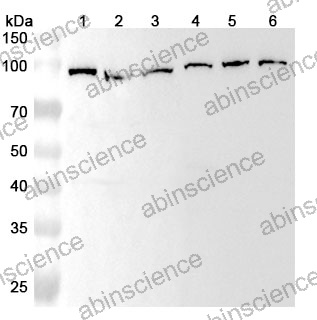
Western blot analysis was performed using anti-KPNB1 polyclonal antibody at 1ug/mL on various samples.
Lane 1: A2780s cell lysate
Lane 2: NIH3T3 cell lysate
Lane 3: Hela cell lysate
Lane 4: K562 cell lysate
Lane 5: A549 cell lysate
Lane 6: Caco2 cell lysate
Contact us for custom quotes, bulk requests and any other issues.
Mail: [email protected]
+86-27-65523339
Building C, No. 666, Shen Dun Si Lu, Wuhan, 430206, China


