
 中文
中文 English
 한국어
한국어 日本語
日本語 Español
 Français
 Русский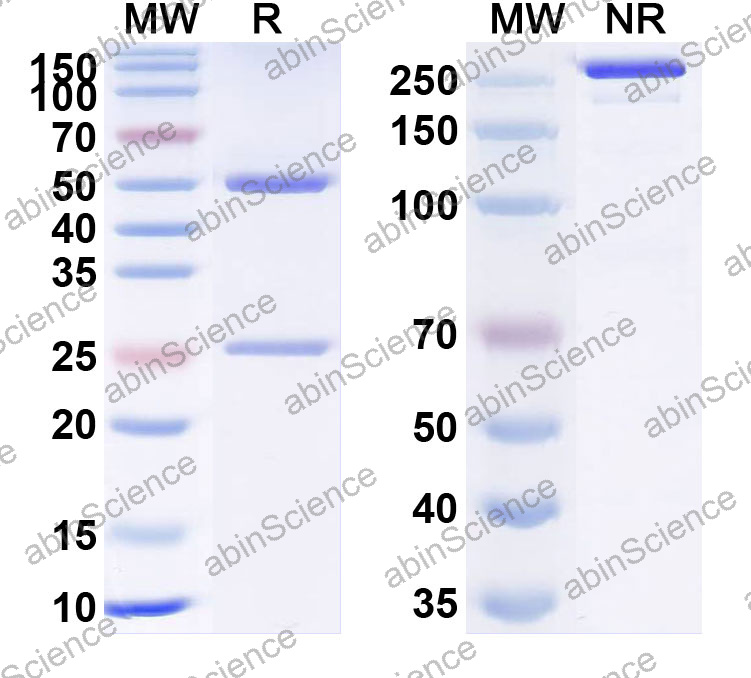
| Catalog No. | HY107015 |
|---|---|
| Description |
Anti-Human NTRK1 Monoclonal Antibody (1A717) [1A717] (HY107015) is a mouse monoclonal antibody detecting NTRK1 in ELISA, IHC, WB. Suitable for Human.
Highlights
|
| Species reactivity | Human |
| Applications | ELISA, IHC, WB |
| Host species | Mouse |
| Clonality | Monoclonal |
| Isotype | IgG |
| Clone ID | 1A717 |
| Immunogen | E. coli - derived recombinant human NTRK1 (Asp38-Phe378). |
| Target | High affinity nerve growth factor receptor, EC:2.7.10.1, Neurotrophic tyrosine kinase receptor type 1, TRK1-transforming tyrosine kinase protein, Tropomyosin-related kinase A, Tyrosine kinase receptor, Tyrosine kinase receptor A, Trk-A, gp140trk, p140-TrkA, NTRK1 |
| Purification | Protein A/G purified from cell culture supernatant. |
| Accession | P04629 |
| Form | Liquid |
| Storage buffer | 0.01M PBS pH 7.4 Please refer to the specific buffer information in the hardcopy of datasheet or the lot-specific COA. |
| Stability and Storage | Use a manual defrost freezer and avoid repeated freeze thaw cycles. Store at 2 to 8°C for frequent use. Store at -20 to -80°C for twelve months from the date of receipt. |
| Background | High affinity nerve growth factor receptor (NTRK1) is a ~87 kDa protein. Receptor tyrosine kinase involved in the development and the maturation of the central and peripheral nervous systems through regulation of proliferation, differentiation and survival of sympathetic and nervous neurons. High affinity receptor for NGF which is its primary ligand. Can also bind and be activated by NTF3/neurotrophin-3. However, NTF3 only supports axonal extension through NTRK1 but has no effect on neuron survival. Upon dimeric NGF ligand-binding, undergoes homodimerization, autophosphorylation and activation. 1. Jing, S. et al. (1992) Neuron 9, 1067-79. PMID: 1281417 2. Tacconelli, A. et al. (2004) Cancer cell 6, 347-60. PMID: 15488758 3. Wehrman, T. et al. (2007) Neuron 53, 25-38. PMID: 17196528 4. Klein, R. et al. (1991) Cell 65, 189-97. PMID: 1849459 5. Hempstead, BL. et al. (1991) Nature 350, 678-83. PMID: 1850821 6. Tong, Q. et al. (2012) FASEB journal : official publication of the Federation of American Societies for Experimental Biology 26, 3811-21. PMID: 22649032 7. Anta, B. et al. (2016) The Journal of biological chemistry 291, 19132-45. PMID: 27445338 8. Barker, PA. et al. (1993) The Journal of biological chemistry 268, 15150-7. PMID: 8325889 |
| Note | For research use only. |
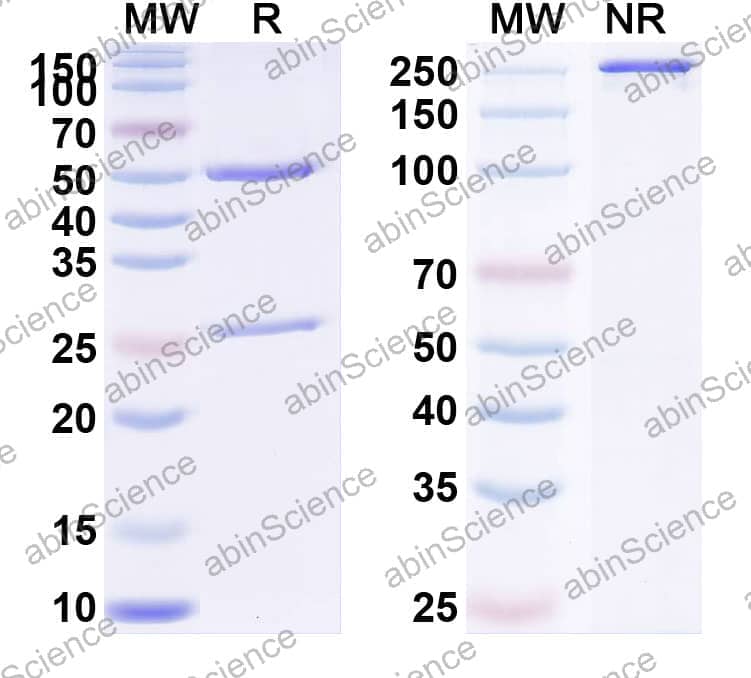
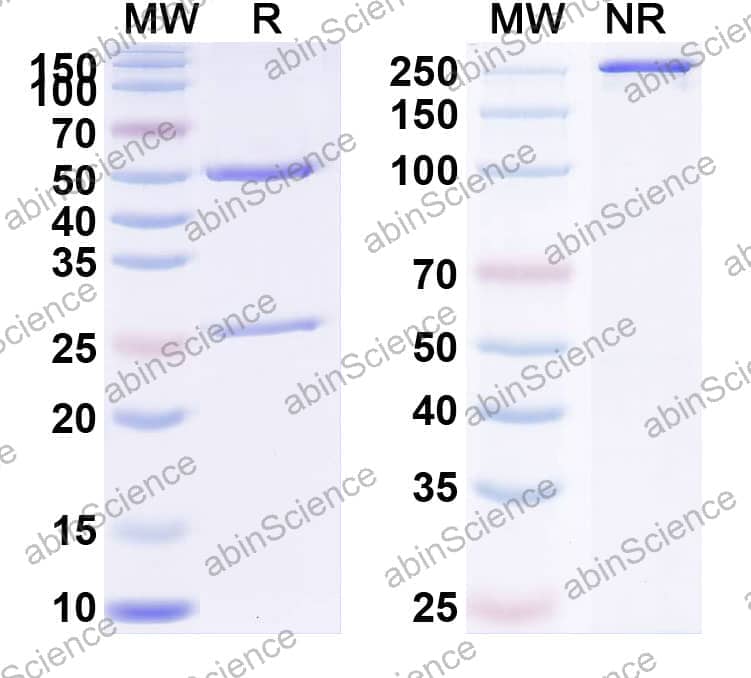
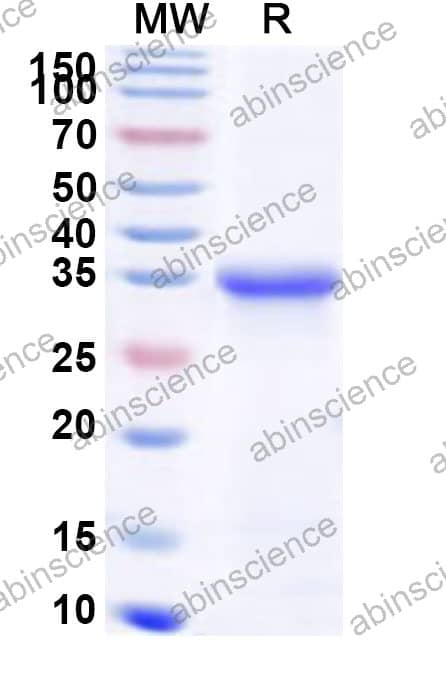
SDS-PAGE for Anti-Human NTRK1 Monoclonal Antibody (1A717)

Contact us for custom quotes, bulk requests and any other issues.
Mail: [email protected]
+86-27-65523339
Building C, No. 666, Shen Dun Si Lu, Wuhan, 430206, China


