
 中文
中文 English
 한국어
한국어 日本語
日本語 Español
 Français
 Русский
| Catalog No. | HB725025 |
|---|---|
| Description |
Anti-Human SLC6A4 Monoclonal Antibody (1A666) [1A666] (HB725025) is a mouse monoclonal antibody detecting SLC6A4 in ELISA, IHC, WB. Suitable for Human.
Highlights
|
| Species reactivity | Human |
| Applications | ELISA, IHC, WB |
| Host species | Mouse |
| Clonality | Monoclonal |
| Isotype | IgG |
| Clone ID | 1A666 |
| Immunogen | E. coli - derived recombinant human SLC6A4 (Ala181-Ser252). |
| Target | Sodium-dependent serotonin transporter, SERT, 5HT transporter, 5HTT, Solute carrier family 6 member 4, SLC6A4 |
| Purification | Protein A/G purified from cell culture supernatant. |
| Accession | P31645 |
| Form | Liquid |
| Storage buffer | 0.01M PBS pH 7.4 Please refer to the specific buffer information in the hardcopy of datasheet or the lot-specific COA. |
| Stability and Storage | Use a manual defrost freezer and avoid repeated freeze thaw cycles. Store at 2 to 8°C for frequent use. Store at -20 to -80°C for twelve months from the date of receipt. |
| Background | Sodium-dependent serotonin transporter (SLC6A4) is a ~70 kDa protein. Serotonin transporter that cotransports serotonin with one Na(+) ion in exchange for one K(+) ion and possibly one proton in an overall electroneutral transport cycle. Transports serotonin across the plasma membrane from the extracellular compartment to the cytosol thus limiting serotonin intercellular signaling. Essential for serotonin homeostasis in the central nervous system. In the developing somatosensory cortex, acts in glutamatergic neurons to control serotonin uptake and its trophic functions accounting for proper spatial organization of cortical neurons and elaboration of sensory circuits. In the mature cortex, acts primarily in brainstem raphe neurons to mediate serotonin uptake from the synaptic cleft back into the pre-synaptic terminal thus terminating serotonin signaling at the synapse. 1. Mortensen, OV. et al. (1999) Brain research. Molecular brain research 71, 120-6. PMID: 10407194 2. Kilic, F. et al. (2003) Molecular pharmacology 64, 440-6. PMID: 12869649 3. Henry, LK. et al. (2011) The Journal of biological chemistry 286, 30823-30836. PMID: 21730057 4. Coleman, JA. et al. (2016) Nature 532, 334-9. PMID: 27049939 5. Hasenhuetl, PS. et al. (2016) The Journal of biological chemistry 291, 25864-25876. PMID: 27756841 6. Yang, D. et al. (2021) Science advances 7, eabl3857. PMID: 34851672 7. Brenner, B. et al. (2007) Journal of neurochemistry 102, 206-15. PMID: 17506858 8. Carneiro, AM. et al. (2008) The Journal of clinical investigation 118, 1544-52. PMID: 18317590 |
| Note | For research use only. |
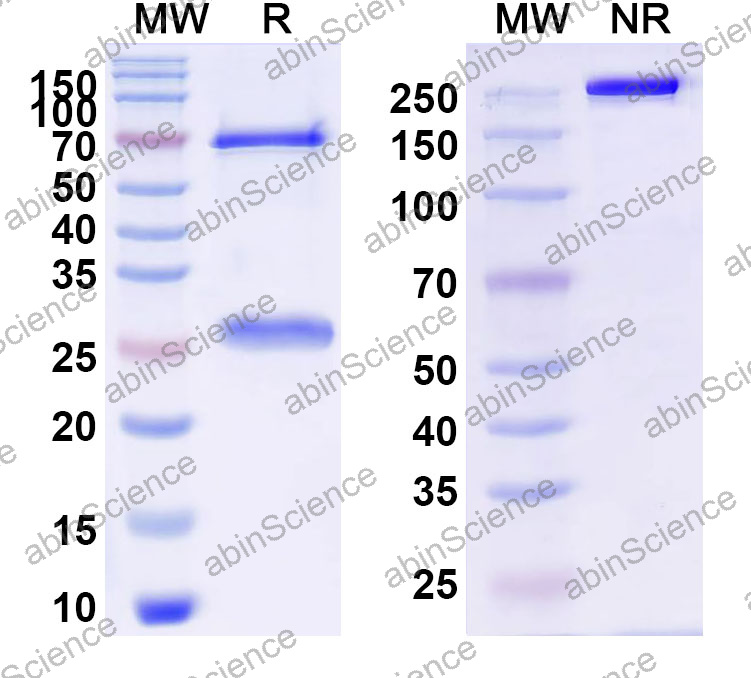
SDS-PAGE for Anti-Human SLC6A4 Monoclonal Antibody (1A666)


Contact us for custom quotes, bulk requests and any other issues.
Mail: [email protected]
+86-27-65523339
Building C, No. 666, Shen Dun Si Lu, Wuhan, 430206, China


