
 中文
中文 English
 한국어
한국어 日本語
日本語 Español
 Français
 Русский
| Catalog No. | MB920012 |
|---|---|
| Description |
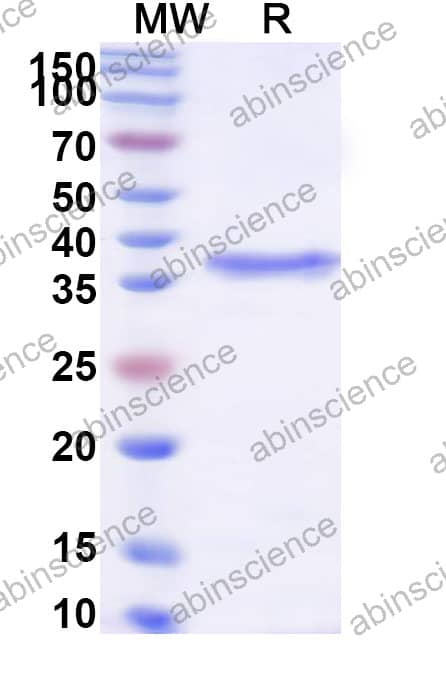
Recombinant Mouse ENPP1 Protein, N-His (MB920012) expressed in E. coli, spanning Lys617-Asp906. Purity: >90% by SDS-PAGE.
Highlights
|
| Expression system | E. coli |
| Accession | P06802 |
| Protein length | Lys617-Asp906 |
| Applications | ELISA, Immunogen, SDS-PAGE, WB, Bioactivity testing in progress |
| Species | Mus musculus (Mouse) |
| Nature | Recombinant |
| Endotoxin level | Please contact with the lab for this information. |
| Purity | >90% as determined by SDS-PAGE. |
| Predicted molecular weight | 36.29 kDa |
| Form | Lyophilized |
| Storage buffer | Lyophilized from a solution in PBS pH 7.4, 0.02% NLS, 1 mM EDTA, 4% Trehalose, 1% Mannitol. Please refer to the specific buffer information in the hardcopy of datasheet or the lot-specific COA. |
| Reconstitution | Reconstitute in sterile water for a stock solution. Adjust the volume of sterile water so that, after reconstitution, the final stock concentration matches the value indicated on the product label or datasheet. RECONSTITUTION PROTOCOL 1. Allow the product to be reconstituted and the reconstitution diluent to reach room temperature. 2. Tap or briefly centrifuge the product vial before opening to dislodge any lyophilized material that may be dispersed on the wall or cap of the vial. 3. Use the diluent and stock concentration recommended in the product datasheet. If preparing a stock concentration higher than recommended, contact Technical Service. 4. After adding the diluent, re-cap the vial and invert gently by hand or place on a slow rocking platform to allow the reconstitution diluent to coat all the surfaces inside the vial. Note: Do not mix by vortexing or by pipetting the material up and down. 5. Allow the vial to sit at room temperature with gentle agitation for at least 15 minutes before aliquotting or using. 6. Store the reconstituted material in single use aliquots in polypropylene or siliconized tubes. Aliquots of 10 μL or larger are recommended. |
| Shipping | In general, proteins are provided as lyophilized powder/frozen liquid. They are shipped out with dry ice/blue ice unless customers require otherwise. |
| Stability and Storage | Use a manual defrost freezer and avoid repeated freeze thaw cycles. Store at 2 to 8°C for frequent use. Store at -20 to -80°C for twelve months from the date of receipt. |
| Alternate Names | Ectonucleotide pyrophosphatase/phosphodiesterase family member 1, E-NPP 1, Lymphocyte antigen 41, Ly-41, Phosphodiesterase I/nucleotide pyrophosphatase 1, Plasma-cell membrane glycoprotein PC-1, Alkaline phosphodiesterase I, 3.1.4.1, Nucleotide pyrophosphatase, NPPase, 3.6.1.9, Nucleotide diphosphatase, Ectonucleotide pyrophosphatase/phosphodiesterase family member 1, secreted form, Enpp1, Npps, Pc1, Pdnp1 |
| Background | Ectonucleotide pyrophosphatase/phosphodiesterase family member 1 (ENPP1) is a ~103 kDa protein. Nucleotide pyrophosphatase that generates diphosphate (PPi) and functions in bone mineralization and soft tissue calcification by regulating pyrophosphate levels. PPi inhibits bone mineralization and soft tissue calcification by binding to nascent hydroxyapatite crystals, thereby preventing further growth of these crystals. Preferentially hydrolyzes ATP, but can also hydrolyze other nucleoside 5' triphosphates such as GTP, CTP and UTP to their corresponding monophosphates with release of pyrophosphate, as well as diadenosine polyphosphates, and also 3',5'-cAMP to AMP. May also be involved in the regulation of the availability of nucleotide sugars in the endoplasmic reticulum and Golgi, and the regulation of purinergic signaling. Inhibits ectopic joint calcification and maintains articular chondrocytes by repressing hedgehog signaling; it is however unclear whether hedgehog inhibition is direct or indirect. 1. Johnson, K. et al. (1999) Journal of bone and mineral research : the official journal of the American Society for Bone and Mineral Research 14, 883-92. PMID: 10352096 2. Johnson, KA. et al. (2000) American journal of physiology. Regulatory, integrative and comparative physiology 279, R1365-77. PMID: 11004006 3. Hessle, L. et al. (2002) Proceedings of the National Academy of Sciences of the United States of America 99, 9445-9. PMID: 12082181 4. Bertrand, J. et al. (2012) Annals of the rheumatic diseases 71, 1249-53. PMID: 22510396 5. Hajjawi, MO. et al. (2014) Bone 69, 139-47. PMID: 25260930 6. Okawa, A. et al. (1998) Nature genetics 19, 271-3. PMID: 9662402 7. Babij, P. et al. (2009) Journal of bone and mineral research : the official journal of the American Society for Bone and Mineral Research 24, 1552-64. PMID: 19419305 |
| Note | For research use only. |
SDS-PAGE for Recombinant Mouse ENPP1 Protein, N-His
Contact us for custom quotes, bulk requests and any other issues.
Mail: [email protected]
+86-27-65523339
Building C, No. 666, Shen Dun Si Lu, Wuhan, 430206, China


