中文
中文 English
 한국어
한국어 日本語
日本語 Español
 Français
 Русский
| Catalog No. | HB716016 |
|---|---|
| Description |
ALD1910 (HB716016) is a research-grade recombinant antibody targeting Pituitary adenylate cyclase-activating polypeptide. Produced in mammalian cells with native-like glycosylation.
Highlights
|
| Species reactivity | Human |
| Applications | ELISA, Bioactivity: FCM, Functional assay, Research in vivo |
| Host species | Human |
| Clonality | Monoclonal |
| Isotype | IgG2 |
| Expression system | Mammalian cells |
| Target | Pituitary adenylate cyclase-activating polypeptide, ADCYAP1, PACAP, PACAP-38, PACAP38, PACAP-27, PACAP27, PRP-48 |
| Endotoxin level | < 10 EU/mg |
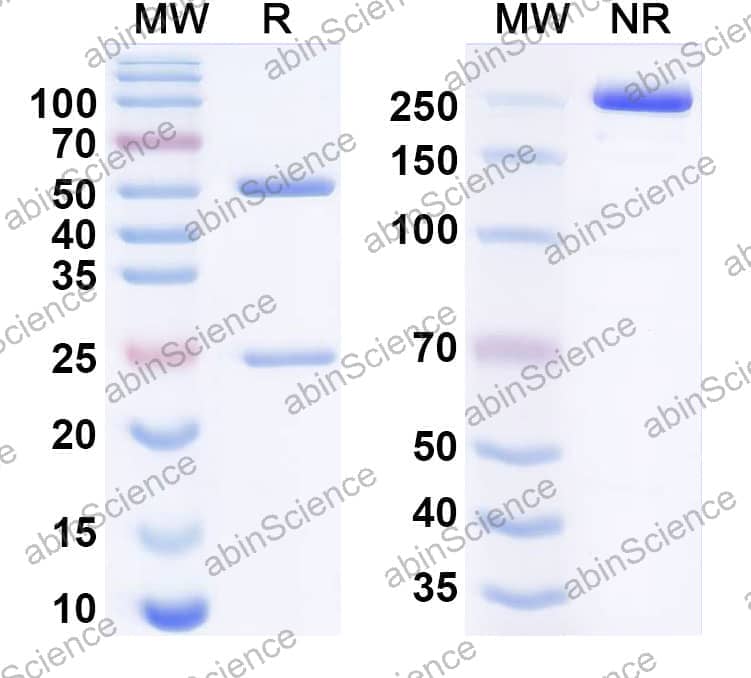
| Purity | >95% as determined by SDS-PAGE. |
| Purification | Protein A/G purified from cell culture supernatant. |
| Accession | P18509 |
| Form | Liquid |
| Storage buffer | 0.01M PBS pH 7.4. Please refer to the specific buffer information in the hardcopy of datasheet or the lot-specific COA. |
| Stability and Storage | Use a manual defrost freezer and avoid repeated freeze thaw cycles. Store at 2 to 8°C for frequent use. Store at -20 to -80°C for twelve months from the date of receipt. |
| Background | Pituitary adenylate cyclase-activating polypeptide (ADCYAP1/PACAP) is a ~18 kDa protein. PACAP is a neuropeptide involved in diverse array of physiological processes through activating the PACAP subfamily of class B1 G protein-coupled receptors: VIP receptor 1 (VIPR1), VIP receptor 2 (VIPR2), and PACAP type I receptor (ADCYAP1R1). Exerts neuroprotective and general cytoprotective effects due to anti-apoptotic, anti-inflammatory, and antioxidant actions. Promotes neuron projection development through the RAPGEF2/Rap1/B-Raf/ERK pathway. In chromaffin cells, induces long-lasting increase of intracellular calcium concentrations and neuroendocrine secretion. Involved in the control of glucose homeostasis, induces insulin secretion by pancreatic beta cells. 1. Inooka, H. et al. (2001) Nature structural biology 8, 161-5. PMID: 11175907 2. Emery, AC. et al. (2013) Science signaling 6, ra51. PMID: 23800469 3. Wang, J. et al. (2020) Cell research 30, 436-445. PMID: 32047270 4. Piper, SJ. et al. (2022) Nature communications 13, 7013. PMID: 36385145 |
| Note | For research use only. Not suitable for clinical or therapeutic use. |
| Isotype Control | Human IgG2 Recombinant Isotype Control Antibody (HyHEL-10) (HV988107) |
Detects Recombinant Human ADCYAP1 Protein, N-GST (Cat No.: HB716012) in indirect ELISA.


Contact us for custom quotes, bulk requests and any other issues.
Mail: [email protected]
+86-27-65523339
Building C, No. 666, Shen Dun Si Lu, Wuhan, 430206, China