Please ensure Javascript is enabled for purposes of website accessibility
Home > Featured Products > Bacteria & Viruses-related products > Porcine epidemic diarrhea virus(PEDV)

Porcine Epidemic Diarrhea Virus (PEDV) Research Reagents — Antibodies & Recombinant Proteins

Porcine epidemic diarrhea virus (PEDV) is an enveloped, positive-sense single-stranded RNA virus belonging to the genus Alphacoronavirus of the family Coronaviridae. PEDV causes acute, severe diarrhea in newborn piglets with mortality rates exceeding 90% in neonatal herds, and remains a major economic threat to global pork production. The viral genome encodes structural proteins including the spike glycoprotein (S), envelope protein (E), membrane protein (M), and nucleoprotein (N), with non-structural proteins including the main protease (3CL-Pro/Mpro) and RNA-dependent RNA polymerase (RdRp). The spike protein is the primary target for neutralizing antibodies and vaccine development, mediating viral attachment to intestinal epithelial receptors. PEDV-specific antibodies and recombinant antigens are essential for vaccine efficacy assessment, diagnostic assay development, and mechanistic studies of viral pathogenesis and host immune responses.

Research Use Only (RUO)Not intended for diagnostic or therapeutic procedures.

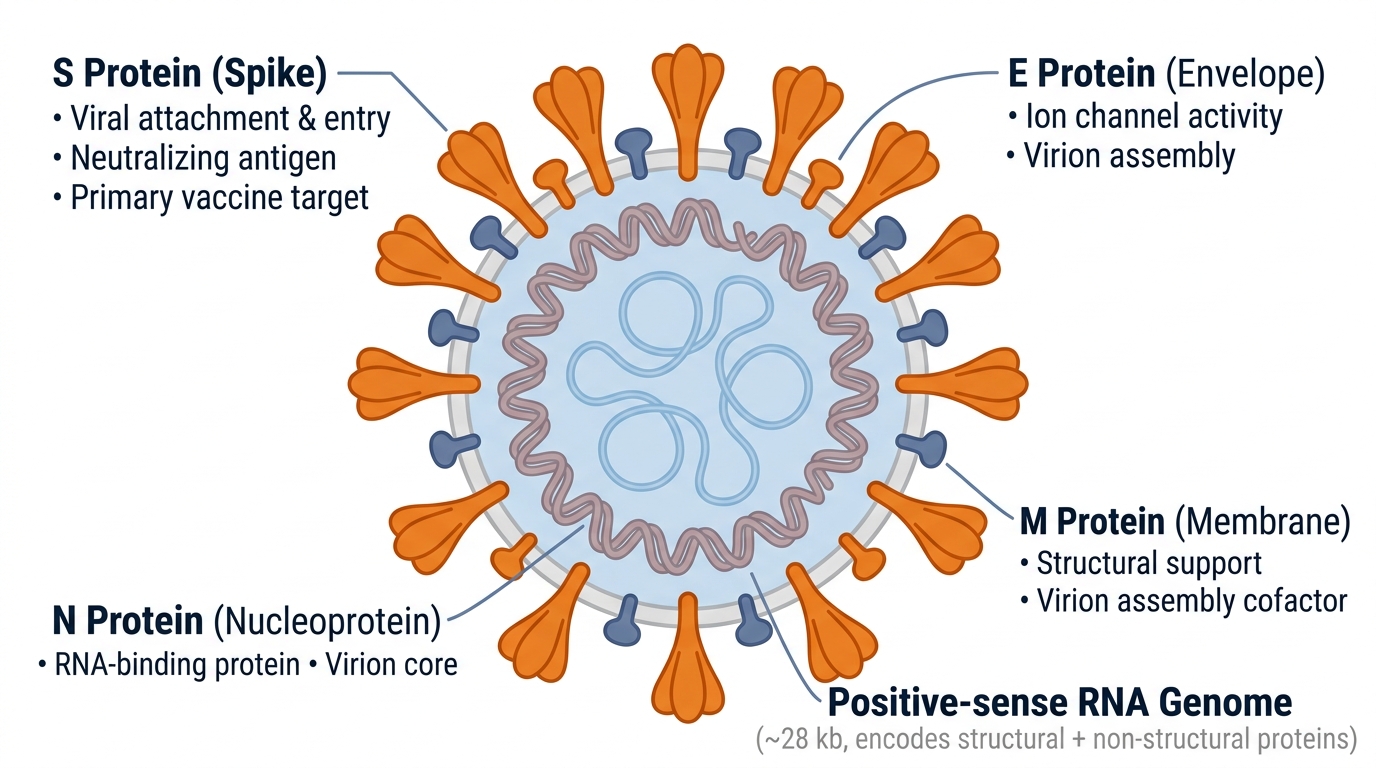
Porcine epidemic diarrhea virus (PEDV) structure — spike protein, envelope, nucleoprotein

Fig. 1 Porcine epidemic diarrhea virus (PEDV) structure. Spike (S) protein mediates viral attachment and entry into intestinal epithelial cells; nucleoprotein (N) forms the ribonucleoprotein complex; envelope (E) and membrane (M) proteins stabilize virion architecture.

abinScience provides monoclonal and polyclonal antibodies, recombinant antigens, and ELISA kits for Porcine epidemic diarrhea virus research. All products manufactured by our parent company AtaGenix Laboratories under ISO 9001 & ISO 13485 quality systems. Contact us for vaccine development and neutralization assays.

Key Research Targets

S/Spike Glycoprotein (S1 & S2 Domains) — The spike protein is the primary viral attachment factor and the major target for neutralizing antibody responses. The S1 domain mediates receptor binding; S2 is responsible for membrane fusion. Spike-specific neutralizing antibodies are highly protective and form the basis of current vaccine strategies and therapeutic interventions. Anti-PEDV S1 (VK564054, VK564024) and anti-PEDV S2 (VK564064, VK564034) polyclonal antibodies enable neutralization assays, vaccine immunogenicity assessment, and epitope mapping studies. Recombinant PEDV spike fragments and RBD (receptor-binding domain) antigens (VK564018, VK564014) serve as immunogens for antibody generation and ELISA coating antigens for serodiagnosis.
→ Browse PEDV Spike products

N/Nucleoprotein (NP) — The nucleoprotein is the most abundantly expressed viral protein, forming the ribonucleoprotein complex with viral RNA. N-specific antibodies are valuable for diagnostic assays, seroprevalence surveys, and viral detection in fecal and serum samples. Unlike spike-specific antibodies, N-specific responses can distinguish between naturally infected and vaccinated animals (DIVA strategy). Anti-PEDV N/nucleoprotein polyclonal antibodies (VK727024, VK727034) support Western blot detection, immunofluorescence, and capture ELISA assay development. Recombinant PEDV nucleoprotein (VK727018) is an excellent ELISA coating antigen and immunological standard for quantitative assays.
→ Browse PEDV Nucleoprotein products

Nsp5/Mpro (Main Protease / 3CL Protease) — The main protease (Mpro or 3CL-Pro) is essential for PEDV polyprotein cleavage and viral replication. Mpro is an attractive target for antiviral drug development and mechanistic studies of viral proteolysis. Anti-PEDV Nsp5/Mpro polyclonal antibody (VK564044) enables detection of this non-structural protein in infected cells and serves as a tool for viral protease inhibitor screening and validation. This target is particularly valuable for therapeutic antibody development and antiviral compound efficacy assessment.
→ Browse PEDV Protease products

Recommended Applications

Vaccine Development & Immunogenicity Assessment
PEDV spike and nucleoprotein recombinant antigens are essential immunogens for vaccine candidate generation. Anti-PEDV antibodies quantify neutralizing antibody responses in vaccinated and naturally infected piglets, enabling potency testing, vaccine efficacy evaluation, and strain-specific immunity assessment. S1/S2-specific antibodies support characterization of vaccine-induced humoral immune responses and prediction of clinical protection.

Diagnostic Assay Development (ELISA, Lateral Flow)
Spike and nucleoprotein recombinant antigens serve as coating and detection antigens for ELISA kits (VK564018 for spike; VK727018 for nucleoprotein). Paired antibodies enable rapid sandwich ELISA assay development for serodiagnosis and fecal antigen detection. N-specific assays support DIVA (Differentiate Infected from Vaccinated Animals) strategies for herd management and outbreak investigation.

Neutralization & Protection Assays
Spike-specific polyclonal antibodies (VK564014, VK564024, VK564054) enable in vitro viral neutralization assays, pseudo-viral particle assays, and passive immunization protection studies. These antibodies quantify the quality and breadth of anti-PEDV responses, supporting vaccine safety/efficacy determination and mechanistic studies of viral escape and antibody-dependent enhancement.

References

1. Song D, Moon HJ, Kang BK. Porcine epidemic diarrhea: a review of antimicrobial susceptibilities, vaccine development, and prevention-control. Virus Res. 2015;206:7-17. doi:10.1016/j.virusres.2015.01.017

2. Jung K, Saif LJ. Porcine epidemic diarrhea virus infection: etiology, epidemiology, pathogenesis and immunoprophylaxis. Vet J. 2015;204(2):134-143. doi:10.1016/j.tvjl.2015.02.017

3. Sun RQ, Cai RJ, Chen YQ, et al. Outbreak of porcine epidemic diarrhea in suckling piglets, China. Emerg Infect Dis. 2007;13(9):1426-1428. doi:10.3201/eid1309.070568

4. Lee S, Lee C. Outbreak-related porcine epidemic diarrhea virus strains similar to US strains in domestic pigs in South Korea, 2013–2014. Infect Genet Evol. 2014;26:428-435. doi:10.1016/j.meegid.2014.06.001

5. Alonso C, Goede DP, Morrison RB, et al. Evidence of infectivity of airborne porcine epidemic diarrhea virus and detection of airborne viral RNA at long distances using high-volume samplers. Vet Res. 2014;45(1):73. doi:10.1186/s13567-014-0073-z

All products manufactured by AtaGenix Laboratories under ISO 9001 & ISO 13485 quality systems. Contact us for custom antibody development.

24 product results for "Porcine epidemic diarrhea virus(PEDV)"

Options+
Options
Confirm
  • Product types
    0 selected
    Proteins (13)
    Antibodies (9)
    Assay Kit (1)
  • Expression system
    0 selected
    E. coli (9)
    Insect cells (2)
    Mammalian cells (2)
  • Target
    0 selected
    Spike glycoprotein (RBD) (1)
    Spike glycoprotein 1 (2)
    Spike glycoprotein (3)
    S1/Spike glycoprotein 1 (2)
    Spike glycoprotein 2 (2)
    NP/Nucleoprotein (1)
    S2/Spike glycoprotein 2 (2)
    RBD (5)
    N/Nucleoprotein (4)
    Nsp5/Mpro/3CL (2)
  • Species
    0 selected
    Porcine epidemic diarrhea virus (PEDV) (13)
  • Applications
    0 selected
    ELISA (24)
    SDS-PAGE (13)
    Immunogen (13)
    WB (21)
    Bioactivity testing in progress (12)
    IHC (8)
  • Reactivity
    0 selected
    Porcine epidemic diarrhea virus (PEDV) (9)
  • Host species
    0 selected
    Rabbit (8)
    Human (1)
  • Clonality
    0 selected
    Polyclonal (8)
    Monoclonal (1)
  • Conjugate
    0 selected
    Unconjugated (2)