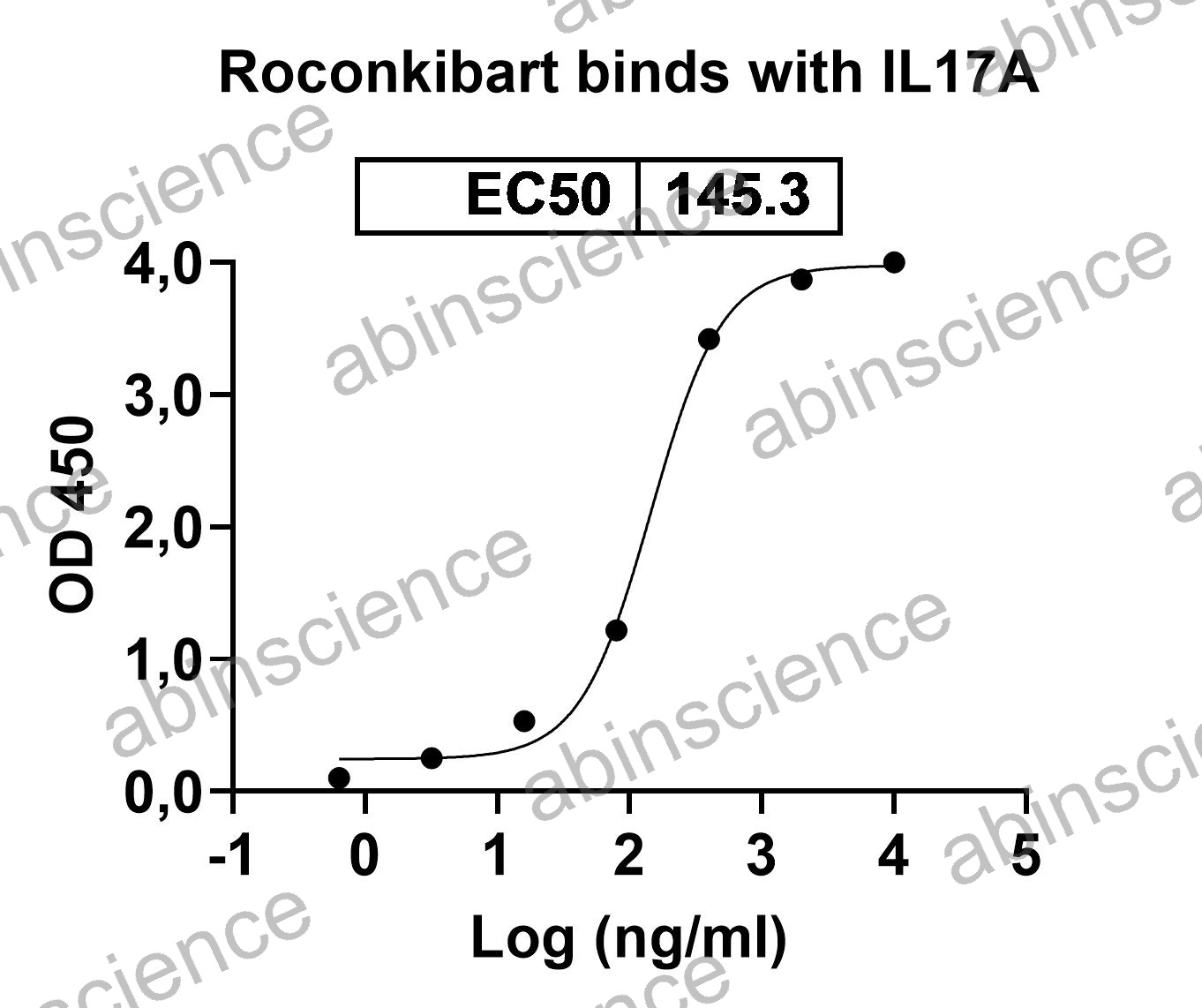
IL-17A (Interleukin-17A / CTLA-8) is the signature cytokine of Th17 cells and a central mediator of chronic inflammation in psoriasis, psoriatic arthritis, ankylosing spondylitis, and other autoimmune conditions. Three anti-IL-17A biologics are FDA-approved — Secukinumab (Cosentyx), Ixekizumab (Taltz), and Bimekizumab (Bimzelx) — with Bimekizumab uniquely targeting both IL-17A and IL-17F. IL-17A is also implicated in host defense against extracellular pathogens and in tumor-promoting inflammation. abinScience offers recombinant IL-17A proteins, anti-IL-17A antibodies, IL-17 receptor proteins, biosimilar reference standards, and ELISA kits.
IL-17A Biology and the IL-17 Family
The IL-17 family comprises six members: IL-17A, IL-17B, IL-17C, IL-17D, IL-17E (IL-25), and IL-17F. IL-17A is the founding and most studied member — a ~35 kDa disulfide-linked homodimer secreted primarily by Th17 cells, γδ T cells, ILC3s, and neutrophils. IL-17A can also form IL-17A/F heterodimers with IL-17F, which share the same receptor complex but have reduced potency compared to IL-17A homodimers.
IL-17A signals through the IL-17RA/IL-17RC heterodimeric receptor complex, activating NF-κB, MAPK, and C/EBP pathways to drive expression of pro-inflammatory mediators including IL-6, IL-8 (CXCL8), G-CSF, CCL20, and antimicrobial peptides (β-defensins, S100A proteins). In autoimmune disease, chronic IL-17A production drives keratinocyte hyperproliferation (psoriasis), synovial inflammation (psoriatic arthritis), and entheseal inflammation (ankylosing spondylitis).
Key Research Applications
Anti-IL-17A Drug Development Recombinant IL-17A homodimer and IL-17A/F heterodimer proteins for screening anti-IL-17 therapeutic antibodies by SPR/BLI, competitive ELISA, and cell-based neutralization assays. IL-17RA and IL-17RC receptor proteins for blocking assays.
IL-17A Neutralization Bioassays Bioactive IL-17A protein for cell-based neutralization assays — stimulate HT-29 or HFF cells with IL-17A and measure IL-6 or IL-8 secretion inhibition by candidate anti-IL-17A antibodies. Activity verified by IL-6 induction EC₅₀.
Biosimilar Comparability Research-grade Secukinumab and Ixekizumab biosimilars for analytical comparability, potency testing, and as reference standards in IL-17A binding and neutralization assays supporting biosimilar development programs.
Serum IL-17A & PK/ADA Assays IL-17A ELISA kits for measuring serum/plasma IL-17A levels in autoimmune disease clinical research. Anti-IL-17A antibody pairs and calibrator proteins for PK and ADA assay development.
IL-17A Product Selection Guide
| Application |
Recommended Product |
Format |
| SPR/BLI binding kinetics |
Recombinant IL-17A protein |
Avi-tagged or biotinylated |
| IL-17A/IL-17F dual neutralization |
IL-17A homodimer + IL-17A/F heterodimer + IL-17F homodimer |
His-tagged (matched format) |
| Cell-based neutralization assay |
Bioactive IL-17A |
Carrier-free, low endotoxin |
| IL-17A/receptor blocking ELISA |
IL-17A + IL-17RA-Fc protein |
His-tagged + Fc-chimera |
| Serum IL-17A quantification |
IL-17A ELISA kit |
Sandwich ELISA |
| Flow cytometry / Th17 profiling |
Anti-IL-17A antibody (intracellular) |
PE or APC conjugated |
| Analytical comparability |
Secukinumab or Ixekizumab biosimilar |
Research-grade RUO |
| PK/ADA ELISA |
Anti-idiotype pair + IL-17A calibrator |
Capture/detection pair |
IL-17A FAQs
What is the difference between Secukinumab, Ixekizumab, and Bimekizumab?
Secukinumab (Cosentyx) is a fully human IgG1κ antibody that selectively neutralizes IL-17A. Ixekizumab (Taltz) is a humanized IgG4 antibody that also selectively neutralizes IL-17A but with higher binding affinity. Bimekizumab (Bimzelx) is a humanized IgG1 bispecific-like antibody that neutralizes both IL-17A and IL-17F, providing broader IL-17 pathway blockade. Clinical data suggest Bimekizumab achieves higher skin clearance rates in psoriasis, possibly due to dual IL-17A/F neutralization.
What is the difference between IL-17A and IL-17F?
IL-17A and IL-17F share ~55% sequence homology and signal through the same IL-17RA/RC receptor complex. However, IL-17A homodimers are 10-30× more potent than IL-17F homodimers in inducing pro-inflammatory gene expression. The IL-17A/F heterodimer has intermediate potency. IL-17F may play a more significant role in mucosal immunity and host defense against certain infections. For drug development, testing candidate antibodies against all three forms (IL-17A, IL-17F, IL-17A/F) clarifies the neutralization breadth.
How do I set up an IL-17A neutralization bioassay?
The standard assay uses HT-29 (human colon adenocarcinoma) or human foreskin fibroblast (HFF) cells stimulated with IL-17A. After 24 hours, measure IL-6 or IL-8 (CXCL8) secretion in the supernatant by ELISA. To test neutralization, pre-incubate IL-17A with serial dilutions of the candidate anti-IL-17A antibody (30-60 min, 37°C) before adding to cells. A potent neutralizing antibody should show dose-dependent inhibition of IL-6/IL-8 production with an IC₅₀ in the low nanomolar range.
How do I detect IL-17A-producing Th17 cells by flow cytometry?
IL-17A is a secreted cytokine, so intracellular staining is required. Stimulate PBMCs with PMA + Ionomycin for 4-6 hours in the presence of a protein transport inhibitor (Brefeldin A or Monensin). Surface-stain for CD3, CD4, then fix, permeabilize, and stain with a fluorochrome-conjugated anti-IL-17A antibody (PE recommended). Gate on live CD3⁺CD4⁺ cells and identify the IL-17A⁺ population as Th17 cells. Include an isotype control or FMO control for accurate gating.
What is the infection risk of IL-17A blockade?
IL-17A plays a critical role in mucosal host defense against extracellular bacteria and fungi — particularly Candida albicans and Staphylococcus aureus. Patients receiving anti-IL-17A therapy have an elevated risk of mucocutaneous candidiasis (oral and esophageal thrush). This is a known class effect of IL-17 pathway blockade. In preclinical studies, Candida infection models are used to evaluate the infection risk profile of anti-IL-17 candidates.
Key References
1. Gaffen SL, et al. (2014) The IL-23–IL-17 immune axis: from mechanisms to therapeutic testing. Nat Rev Immunol. 14(9):585-600. PMID: 25145755
2. Langley RG, et al. (2014) Secukinumab in plaque psoriasis — results of two phase 3 trials. N Engl J Med. 371(4):326-338. PMID: 25007392
3. Adams R, et al. (2020) Bimekizumab, a novel humanized IgG1 antibody that neutralizes both IL-17A and IL-17F. Front Immunol. 11:519959. PMID: 33193340


 中文
中文 English
 한국어
한국어 日本語
日本語 Español
 Français
 Русский