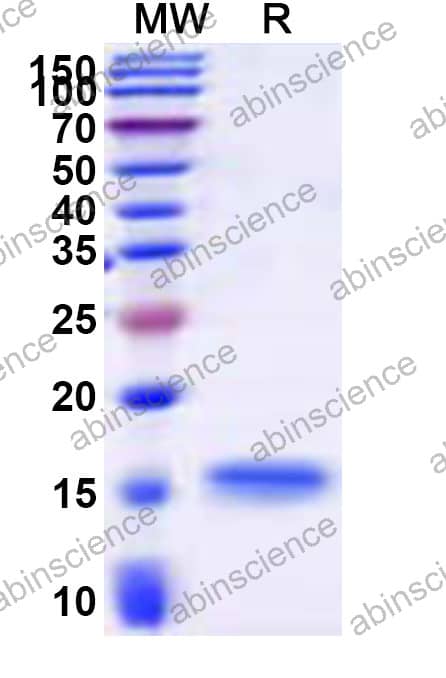
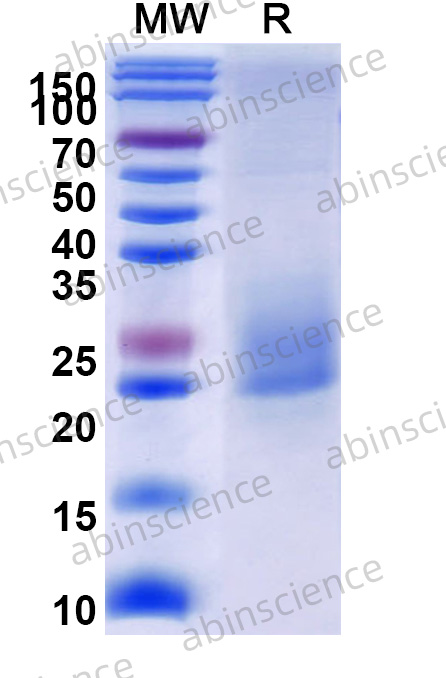
Recombinant Human CD82 Protein, C-Fc (HB018021) expressed in Mammalian Cells, spanning Gly111-Leu228. Purity: >90% by SDS-PAGE.
Highlights
●Fc Fusion — Enhanced stability with Protein A/G purification compatibility.
●Mammalian Expression — Proper folding and native glycosylation.
●High Purity — >90% purity verified by SDS-PAGE.
Expression system
Mammalian cells
Accession
P27701
Protein length
Gly111-Leu228
Applications
ELISA, Immunogen, SDS-PAGE, WB, Bioactivity testing in progress
Species
Homo sapiens (Human)
Nature
Recombinant
Endotoxin level
Please contact with the lab for this information.
Purity
>90% as determined by SDS-PAGE.
Predicted molecular weight
41.88 kDa
Form
Lyophilized
Storage buffer
Lyophilized from a solution in PBS pH 7.4, 1 mM EDTA, 4% Trehalose, 1% Mannitol.
Please refer to the specific buffer information in the hardcopy of datasheet or the lot-specific COA.
Reconstitution
Reconstitute in sterile water for a stock solution. A copy of datasheet will be provided with the products, please refer to it for details.
Shipping
In general, proteins are provided as lyophilized powder/frozen liquid. They are shipped out with dry ice/blue ice unless customers require otherwise.
Stability and Storage
Use a manual defrost freezer and avoid repeated freeze thaw cycles. Store at 2 to 8°C for frequent use. Store at -20 to -80°C for twelve months from the date of receipt.
CD82 antigen is a ~29 kDa protein. Structural component of specialized membrane microdomains known as tetraspanin-enriched microdomains (TERMs), which act as platforms for receptor clustering and signaling. Participates thereby in diverse biological functions such as cell signal transduction, adhesion, migration and protein trafficking. Acts as a attenuator of EGF signaling, facilitating ligand-induced endocytosis of the receptor and its subsequent desensitization. Mechanistically, modulates ligand-induced ubiquitination and trafficking of EGFR via E3 ligase CBL phosphorylation by PKC. Increases cell-matrix adhesion by regulating the membrane organization of integrin alpha4/ITA4.
1. Xu, C. et al. (2009) FASEB journal : official publication of the Federation of American Societies for Experimental Biology 23, 3273-88. PMID: 19497983
2. Odintsova, E. et al. (2000) Current biology : CB 10, 1009-12. PMID: 10985391
3. Bu, J. et al. (2022) Acta biochimica et biophysica Sinica 54, 400-408. PMID: 35538033
4. Odintsova, E. et al. (2013) The Journal of biological chemistry 288, 26323-26334. PMID: 23897813
5. Termini, CM. et al. (2014) Molecular biology of the cell 25, 1560-73. PMID: 24623721
6. Mannion, BA. et al. (1996) Journal of immunology (Baltimore, Md. : 1950) 157, 2039-47. PMID: 8757325
7. He, B. et al. (2005) The Journal of biological chemistry 280, 3346-54. PMID: 15557282
8. Jee, BK. et al. (2007) Biochemical and biophysical research communications 359, 703-8. PMID: 17560548
9. Bass, R. et al. (2005) The Journal of biological chemistry 280, 14811-8. PMID: 15677461
10. Lee, H. et al. (2023) BMB reports 56, 359-364. PMID: 36945827

 中文
中文 English
 한국어
한국어 日本語
日本語 Español
 Français
 Русский